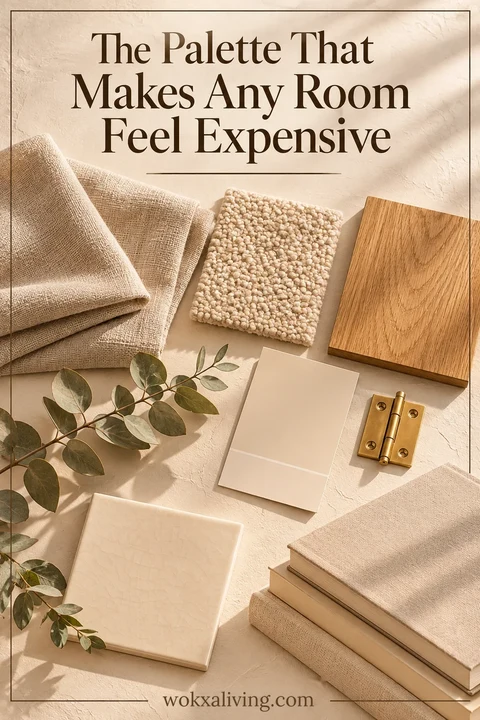
Why Your Room Feels Flat, and How Texture Fixes It
A room can have good furniture, good color and still feel like a showroom. What is usually missing is texture.
 Wokxa Living·Nov 15, 2026·6 min read
Design illustration created for Wokxa Living. It shows the idea, not a specific product.
Image: an AI-styled illustration of the idea, made for Wokxa Living. It does not show a specific product.
You paint the walls the right shade, buy a sofa you like, hang something on the wall, and the room still looks like a photo of a room rather than a place anyone lives.
Nine times out of ten the problem is not color and not furniture. It is that everything in the room has the same surface. Smooth paint, smooth upholstery, smooth laminate, smooth glass. Light hits all of it the same way, so nothing catches the eye and the whole space reads as flat.
Texture is the fix, and it costs very little. You are not buying new furniture, you are changing what light does when it lands. Here is how to think about it.
Why texture does the heavy lifting
Every surface in a room either absorbs light or bounces it. A matte plaster wall swallows light. A brass handle throws it back. Oiled oak does both, depending on where you stand.
When a room contains only one kind of surface, there is nothing for your eye to stop on, so the space feels thin even when it is full. Mix three or four kinds and the same room gains depth without a single new piece of furniture.
This is also why expensive-looking rooms photograph well. It is rarely the price of the furniture. It is that the materials are doing different things with the light.
The five textures worth having
Something chunky
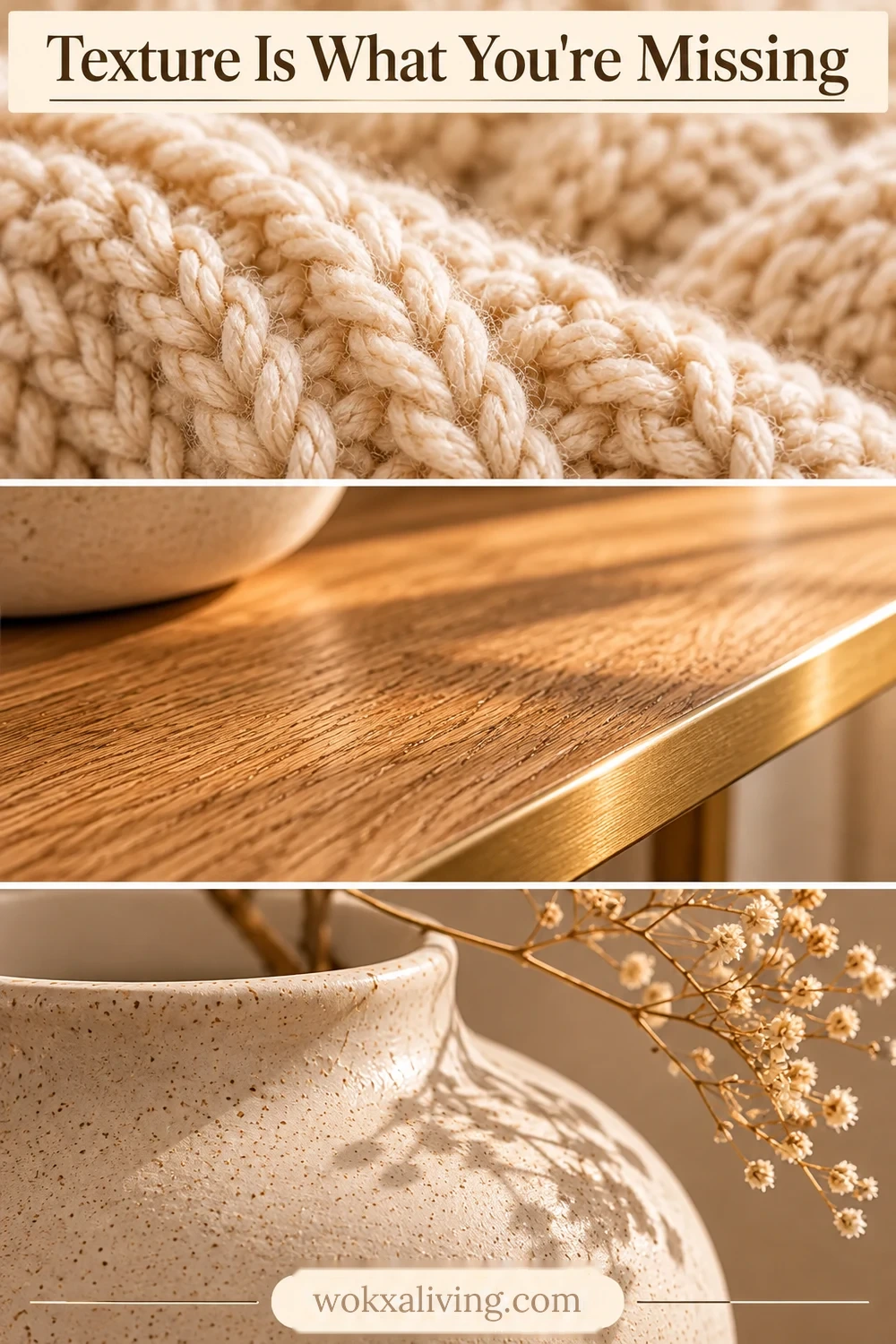
A thick knit throw, a boucle cushion, a jute rug. Deep, irregular surfaces cast tiny shadows across themselves, which is what makes them read as soft before you have touched anything. One chunky piece per seating area is plenty.
Something smooth and warm
Oiled or waxed wood, in a mid tone rather than orange or grey. Wood grain gives you fine, quiet pattern that never competes with anything else in the room.
Something matte and solid
Unglazed or lightly glazed ceramic, plaster, stone. Matte surfaces create a soft edge where they meet the light, which stops a room looking glossy and hard.
Something reflective, in small doses
Brass, aged bronze, glass, a mirror. Keep this to roughly a tenth of what you can see. Reflective finishes are punctuation, not paragraphs.
Something living or once living
A real plant, dried stems, a branch. Organic shapes are irregular in a way manufactured things never are, and one is usually enough in a small room.
Looking for faux stems and vases?
Our guide covers faux flowers that look real, plus how to style them so they do not look plastic.
Where to add texture, room by room
You do not need all five in every room. Aim for three or four within what the eye takes in at once.
- Living room: a chunky throw over the arm of the sofa, a wood coffee table or side table, one matte ceramic vase, a brass tray or candle holder.
- Bedroom: layered bedding in two different weaves, a wood or rattan headboard, linen curtains instead of synthetic ones.
- Entryway: a jute or wool runner, a woven basket for shoes, a wood surface, one mirror.
- Kitchen: a wood board left out on the counter, linen tea towels, open shelves with ceramics instead of everything behind cabinet doors.
- Bathroom: rolled cotton towels, a wood stool or tray, one plant that tolerates damp.
Common mistakes
- Everything in one material. All wood, or all grey fabric, flattens a room just as much as all plastic does. Variety is the point.
- Too much shine. Glass table, mirrored cabinet, chrome lamp and satin cushions together feels like a hotel lobby. Pick one reflective piece per area.
- Textures that are all the same scale. A fine knit cushion next to fine linen next to fine cotton reads as one texture. Put something coarse next to something fine so the contrast is visible.
- Forgetting the floor and the windows. They are the two biggest surfaces in any room. A rug and a decent curtain fabric change more than a shelf of accessories ever will.
- Buying texture you cannot live with. A very loose weave sheds and a pale boucle shows every mark. Think about the room before the photo.
One quick test: stand in the doorway and squint until the detail disappears. If the room turns into a single flat block of tone, it needs contrast. If you can still make out distinct light and dark patches, the texture is doing its job.
Quick questions
How many textures are too many?
Three or four different surfaces within one view is a good target. Past about five, the room starts to look busy rather than layered.
Does texture work in a very small room?
Yes, and it matters more there. A small room with one material feels like a box. Keep the pieces small, and use the floor and the bed or sofa to carry the texture.
Do I have to use neutral colors for this?
No. Texture is about surface, not color. A deep green velvet cushion and a pale linen one are two textures and two colors, and both can be in the same room.
What is the cheapest place to start?
A throw and a rug. Together they cover a lot of visible surface, and neither requires drilling or moving furniture.