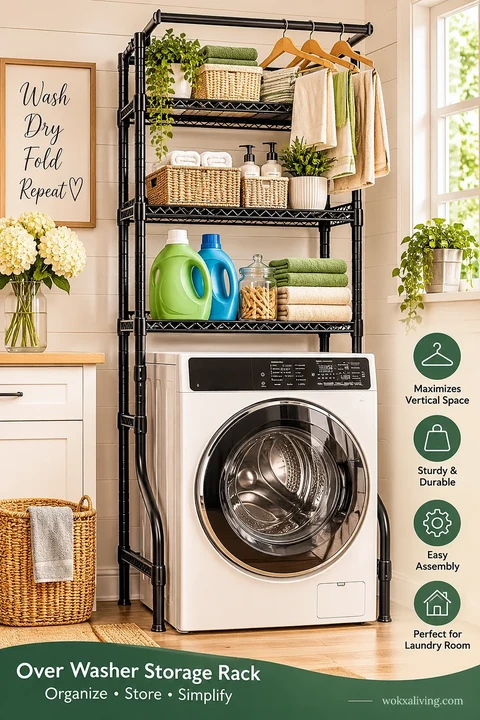
Small Laundry Room Ideas: How to Use the Wall Above Your Washer
The space above the machine is the most wasted spot in a small laundry room. Here is how to measure it, fill it and keep it tidy.
 Wokxa Living·Nov 12, 2026·5 min read
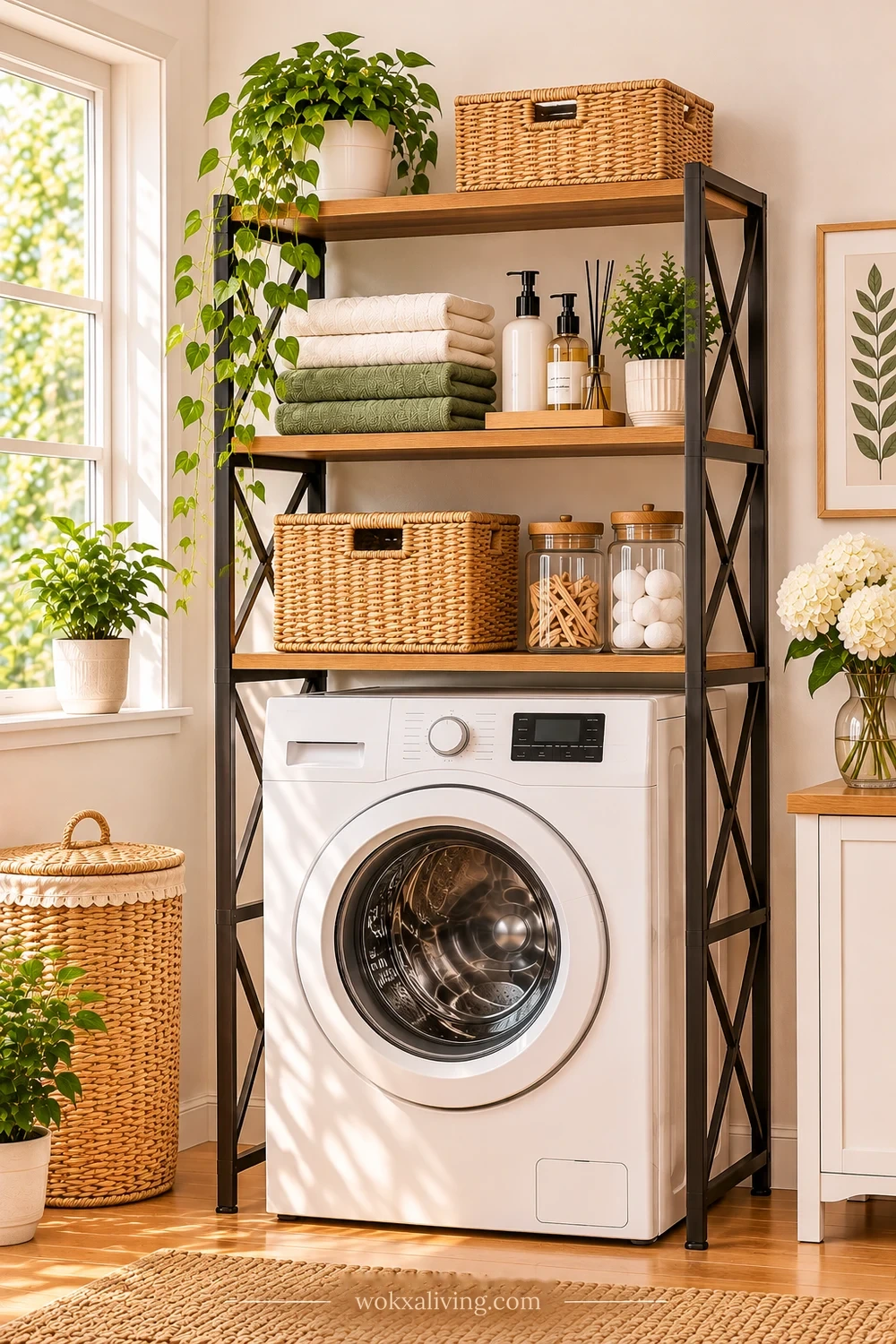
Design illustration created for Wokxa Living. It shows the idea, not a specific product.
Image: an AI-styled illustration of the idea, made for Wokxa Living. It does not show a specific product.
In a small laundry room, the floor is already taken. The washer sits there, perhaps a dryer beside it, and whatever is left over becomes a pile of bottles and a basket you step around.
Look up, though, and there is usually a full metre of empty wall above the machine. That space is the same width as the washer, it is right where you stand when you do the laundry, and in most homes it holds nothing at all.
Using it well takes a little planning, because a washing machine shakes, gives off damp air and needs to be opened and serviced. This guide covers what to measure, the three ways to add storage, and how to load the shelves so they stay useful.
Measure before you buy anything
Ten minutes with a tape measure saves a return. Write these down:
- The width of the machine, plus a little. Most front loaders are about 60 cm wide (close to 27 inches for many US models). Any frame that stands over it needs a few centimetres spare on each side so the machine can vibrate without knocking it.
- The height to the top of the machine. Then add clearance. The lowest shelf should sit at least 10 to 15 cm above the top so you can reach the detergent drawer and lift the unit out for repairs.
- The lid, if it is a top loader. A top loading lid swings up 40 to 50 cm. Open it fully and measure to the highest point before you plan a shelf above it.
- Taps, hoses and sockets. Note where the water valves and the plug are. You need to reach them quickly if there is a leak, so do not box them in.
- The ceiling height. Tall shelf units are often 150 to 180 cm high. Check that it fits under a low ceiling, a boiler or a window frame.
Three ways to use the wall
A freestanding shelf unit over the machine
A frame that stands on the floor with its legs either side of the washer and two or three shelves above. There is no drilling, so it suits renters, and you can take it with you when you move. Look for adjustable feet for uneven floors and fix the top to the wall with the safety strap if one is included, because a tall narrow frame can tip.
Wall mounted shelves
Two or three sturdy shelves fixed to the wall studs. This leaves the floor completely clear and looks the cleanest, but it needs a drill, the right wall fixings and a wall that can take the weight. It is the better choice if you own the home and the machine will stay in the same place.
A rail with hooks and baskets
For a very narrow nook, a single rail with hanging baskets and a short hanging rod for shirts may be all that fits. It holds less, but it keeps the things you use every wash within reach.
Looking at an over washer shelf?
See our guide to a 3 tier freestanding laundry shelf, with the pros, the cons and what owners say.
How to load the shelves
The order matters more than the containers. Think about weight, reach and damp.
- Lowest shelf: daily items. Detergent, softener and stain remover go here, at eye level or just below. Stand heavy liquids on a small tray so a drip does not run down onto the machine.
- Middle shelf: folded things. Spare towels, cleaning cloths and a basket for odd socks.
- Top shelf: light and rarely used. Spare baskets, extra supplies and a plant. Nothing heavy goes up high above a machine that shakes on the spin cycle.
- Decant only what helps. Glass jars look good for pegs, dryer balls and pods. Keep liquids in their original bottles if there are children in the home, so the safety cap and the label stay with the product.
- Leave some air. A shelf filled edge to edge looks crowded and is harder to keep clean. Aim to leave about a quarter of each shelf empty.
Common mistakes to avoid
- Resting anything on the machine itself. The top of a washer vibrates. Bottles walk to the edge and fall, and weight on the lid can damage it.
- Ignoring the weight limit. Detergent is heavy. A full large bottle can weigh four kilos or more. Check the stated limit for each shelf and stay under it.
- Blocking the vents. A dryer needs air around it. Leave the gap the manual asks for and never store things against the vent.
- Cardboard in a damp room. Boxes soften and grow mould. Use plastic, glass, metal or sealed woven baskets instead.
- Forgetting the lint. Open shelves near a dryer collect dust and lint. Wipe them once a month and keep fabrics in baskets.
One last check: after the first few washes, look at the frame while the machine is on its fastest spin. If anything rattles, the feet need adjusting or the unit is touching the machine.
Quick questions
Is it safe to put shelves above a washing machine?
Yes, as long as the shelf does not rest on the machine, heavy items sit low, and a tall freestanding unit is strapped to the wall so it cannot tip.
How much space should I leave above the washer?
Leave at least 10 to 15 cm between the top of a front loader and the first shelf. For a top loader, the shelf must clear the lid when it is fully open.
Will this work in a rented flat?
A freestanding unit needs no drilling and leaves no marks, so it is the usual choice for renters.
Can I put the same kind of shelf over a dryer?
Usually yes, but check the dryer manual for the clearance it needs around the vent and keep anything flammable away from the hot air outlet.