Why Your Room Feels Cold at Night, and How to Fix the Lighting
Nothing is wrong with your furniture. One ceiling light is doing all the work, and it is the wrong kind.
 Wokxa Living·Nov 15, 2026·7 min read
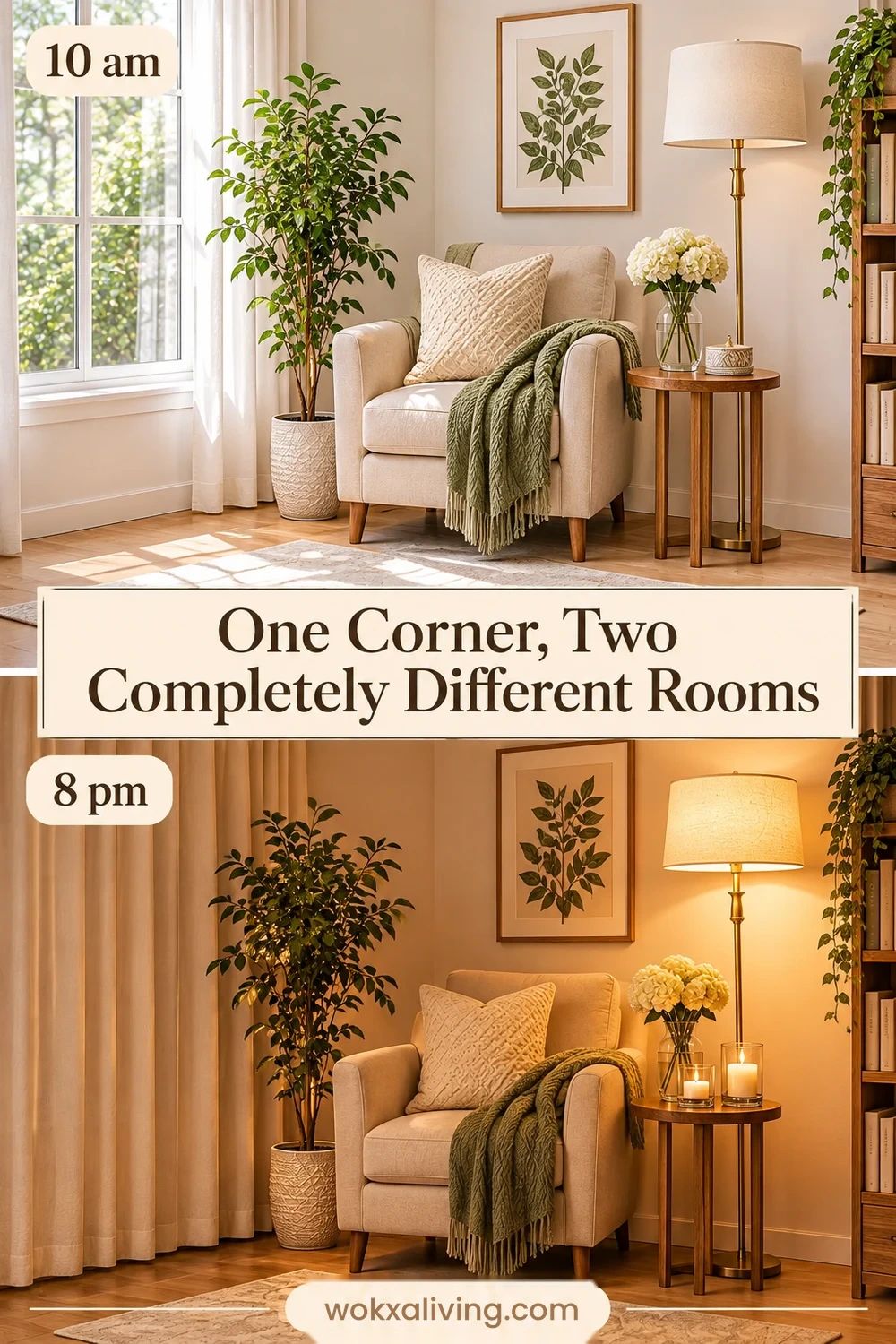
Design illustration created for Wokxa Living. It shows the idea, not a specific product.
Image: an AI-styled illustration of the idea, made for Wokxa Living. It does not show a specific product.
Plenty of rooms look lovely at four in the afternoon and feel like a waiting room by eight. The furniture has not moved. The light has.
Daylight comes in sideways, fills the room evenly and changes slowly. A single ceiling fitting comes straight down, flattens every face and surface under it, and never changes at all. That is the whole problem in one sentence.
The fix is not expensive. It is a few lamps in the right places and the right bulbs in them. Here is how to do it properly.
The three layers of light
Designers talk about layers because a room needs light at three different heights, doing three different jobs.
Ambient: the general level
The ceiling light, or uplighting. It stops the room being dark and nothing more. Put it on a dimmer if you can, and plan to use it at about half brightness in the evening.
Task: light where you do things
A floor lamp beside the reading chair, a lamp on the desk, a light under the kitchen cabinets. Bright, directional, close to the work.
Accent: light that sets the mood
Table lamps, candles, a small lamp on a shelf. This is the layer most homes are missing, and the one that makes a room feel warm at night.
Looking for a pair of lamps?
Our guide to ceramic bedside table lamps covers sizing, shade height and what owners say.
Which bulbs to buy, with numbers
Bulb color is measured in kelvin, and it is printed on the box. This one number changes a room more than any lamp you buy.
- 2200 to 2400K: very warm, close to candlelight. Lovely for accent lamps and bedrooms, too dim and yellow for a whole room.
- 2700K: the standard warm white, and the right default for living rooms and bedrooms. If you buy one thing from this guide, buy these.
- 3000K: slightly crisper. Fine for kitchens and bathrooms where you want to see clearly.
- 4000K and above: cool white and daylight. Right for a garage or a workshop. In a living room it reads as institutional, and it is the single most common reason a room feels cold at night.
- Match them. Mixing 2700K and 4000K bulbs in one room looks worse than using the wrong one consistently. Check every bulb in the room and make them agree.
- Check the dimming. Not every LED dims, and the cheap ones flicker when they do. Look for dimmable on the box if the lamp is on a dimmer.
Where to put the lamps
Three light sources at different heights in one room is the usual target. Four in a large one.
- Beside a reading chair: a floor lamp just behind your shoulder. When seated, the bottom of the shade should sit near eye level so the bulb never glares.
- Either side of a bed: a matching pair on the nightstands. Bottom of the shade around 20 inches above the mattress.
- On a console or sideboard: one lamp towards one end, not centred. Centred looks formal and a little dead.
- In the dark corner: every room has one. A small lamp or an uplight there does more than another light in the middle.
- Low down: one light source below waist height, a lamp on a low table or a floor uplight, is what makes the evening version of a room feel settled.
Common mistakes
- Relying on the ceiling light. One source overhead creates hard shadows under everything, faces included. It is the lighting equivalent of a camera flash.
- Cool bulbs in a warm room. All the oak and linen in the world cannot survive 5000K light.
- Shades that are too small. A shade narrower than the base looks pinched and throws a tight cone of light. Wider is almost always better.
- No dimmer anywhere. A dimmer is the cheapest upgrade in this entire guide, and it turns one fitting into three moods.
- Forgetting candles. A real flame moves, and movement is what a room full of static LEDs lacks. Two candles at dusk change a room more than another lamp.
A quick test: at night, turn off the ceiling light and see whether the room still works. If it goes dark, you are short a layer. Add one lamp in the darkest corner and try again.
Quick questions
What color temperature is best for a living room?
2700K warm white suits most living rooms and bedrooms. Go to 3000K in kitchens and bathrooms where you need clearer light.
How many lamps does one room need?
Three light sources at different heights for an average room, four in a large one, counting the ceiling light as one of them.
Why do my rooms look yellow in photos but fine in person?
Your eyes adapt to warm light and a camera does not. Set the white balance on your phone or take photos while there is still some daylight.
Are smart bulbs worth it?
They are useful if your fittings are not on dimmers, because they let you drop the brightness in the evening. If you already have dimmers, ordinary 2700K bulbs do the same job for less.