How to Style a Floating Shelf: Three Looks That Always Work
The same shelf can read calm, cozy or collected. Here is exactly what changes between them.
 Wokxa Living·Nov 15, 2026·6 min read
Design illustration created for Wokxa Living. It shows the idea, not a specific product.
Image: an AI-styled illustration of the idea, made for Wokxa Living. It does not show a specific product.
A floating shelf is the easiest thing to put on a wall and the easiest thing to get wrong. Too little and it looks forgotten. Too much and it looks like a junk drawer at eye level.
There are really only three looks worth learning, and the difference between them is not what you own. It is how many pieces you use, how much space you leave, and whether you build in layers or in a line.
Work through them in order. Each one adds to the last, so you can stop wherever the shelf starts to feel right.
The three looks
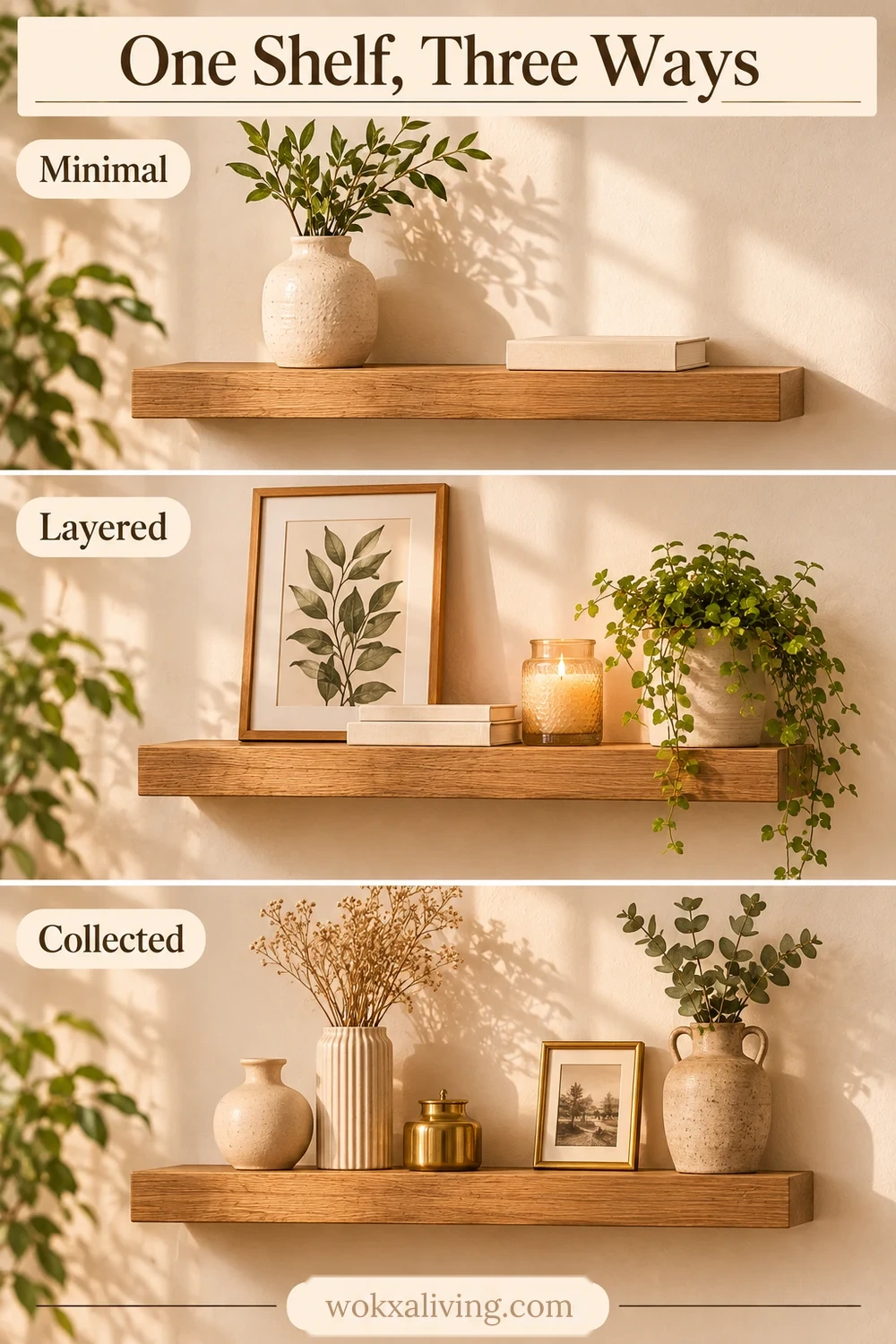
Minimal: two pieces, lots of air
One object with height, one with weight. A ceramic vase and a single book laid flat is enough. Put them off centre rather than in the middle, and leave at least half the shelf empty. This look suits narrow hallways, bathrooms and any wall that already has a lot going on near it.
Layered: build front to back
Lean a framed print against the wall, then set a short stack of books in front of it, then a candle, then a trailing plant at one end. Three depths and three heights. This is the look most people want and the one that photographs best, because the overlap creates shadow.
Collected: odd numbers, varied heights
Five or seven small objects, grouped in twos and threes rather than spread evenly. Mix a tall vase, a short jar, something brass and something organic. The trick is grouping: clusters with gaps read as collected, evenly spaced objects read as a shop display.
Need the shelves themselves?
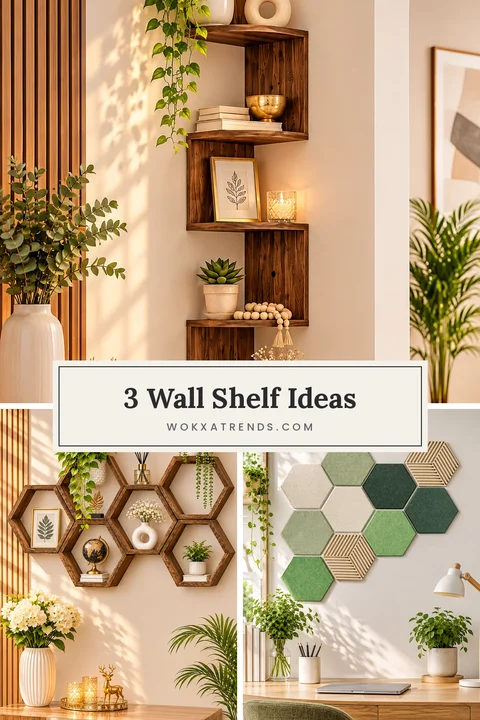
Three wall shelf ideas for a blank wall or an empty corner, with what to check before you drill.
Rules that apply to all three
- Work in odd numbers. Three or five objects, or three groups. Even numbers sit symmetrically and symmetry on a shelf looks static.
- Vary the height. The tallest piece should be roughly twice the shortest. If everything is the same height, the eye slides straight along without stopping.
- Leave a third empty. Negative space is what separates styled from stacked. Measure it if you have to.
- Repeat one material. The same wood tone, the same metal, or two ceramics in the same glaze. Repetition is what makes a random group look chosen.
- Keep the heavy things low. Visually and literally. Books flat on the shelf, light objects on top of them.
Height and spacing, with numbers
Styling only works if the shelf is in the right place to begin with.
- Above a sofa or desk: leave 8 to 10 inches of clear wall between the top of the furniture and the underside of the shelf.
- A single shelf on a bare wall: put the shelf itself near eye level, around 57 to 60 inches from the floor.
- Two or three stacked shelves: 12 to 15 inches apart is comfortable. Closer than 10 and tall objects will not fit.
- Width: a shelf should be at least two thirds the width of whatever sits below it, or it will look undersized.
- Weight: check the stated limit before loading books. Most decorative floating shelves are built for ceramics and frames, not hardbacks.
Common mistakes
- Everything the same height. The most common one, and the easiest to fix. Lay a book flat and stand something on it.
- Spacing objects evenly. Even gaps look like a display case. Cluster instead.
- Pushing everything flat against the wall. Depth is what creates shadow. Pull the front pieces forward.
- Too many small things. Five tiny objects read as clutter from across the room. One larger piece does more.
- Styling for the camera, not the room. If you cannot reach your coffee cup past the styling, something has to go.
When a shelf still looks wrong, take everything off and start with two pieces. Add one at a time and stop the moment it stops improving. That point usually arrives earlier than expected.
Quick questions
How many things should go on a floating shelf?
Between two and seven depending on the look. Minimal is two or three, layered is four or five, collected is five to seven arranged in groups.
Can floating shelves hold books?
Only if the stated weight limit allows it and the brackets are fixed into studs. Most small decorative shelves are not built for a row of hardbacks.
What goes on a shelf above a desk?
Keep it to three pieces so the wall stays calm while you work: one plant, one framed piece leaning back, and a small tray or jar for the things that collect on the desk.
How do I stop a shelf looking cluttered?
Remove a third of what is on it and leave that space empty. Clutter is almost always a spacing problem rather than a quantity problem.