How to Light Built-In Shelves So the Whole Wall Glows
The strip you buy matters far less than where you hide it. Most lit shelves fail for the same three reasons.
 Wokxa Living·Nov 23, 2026·8 min read
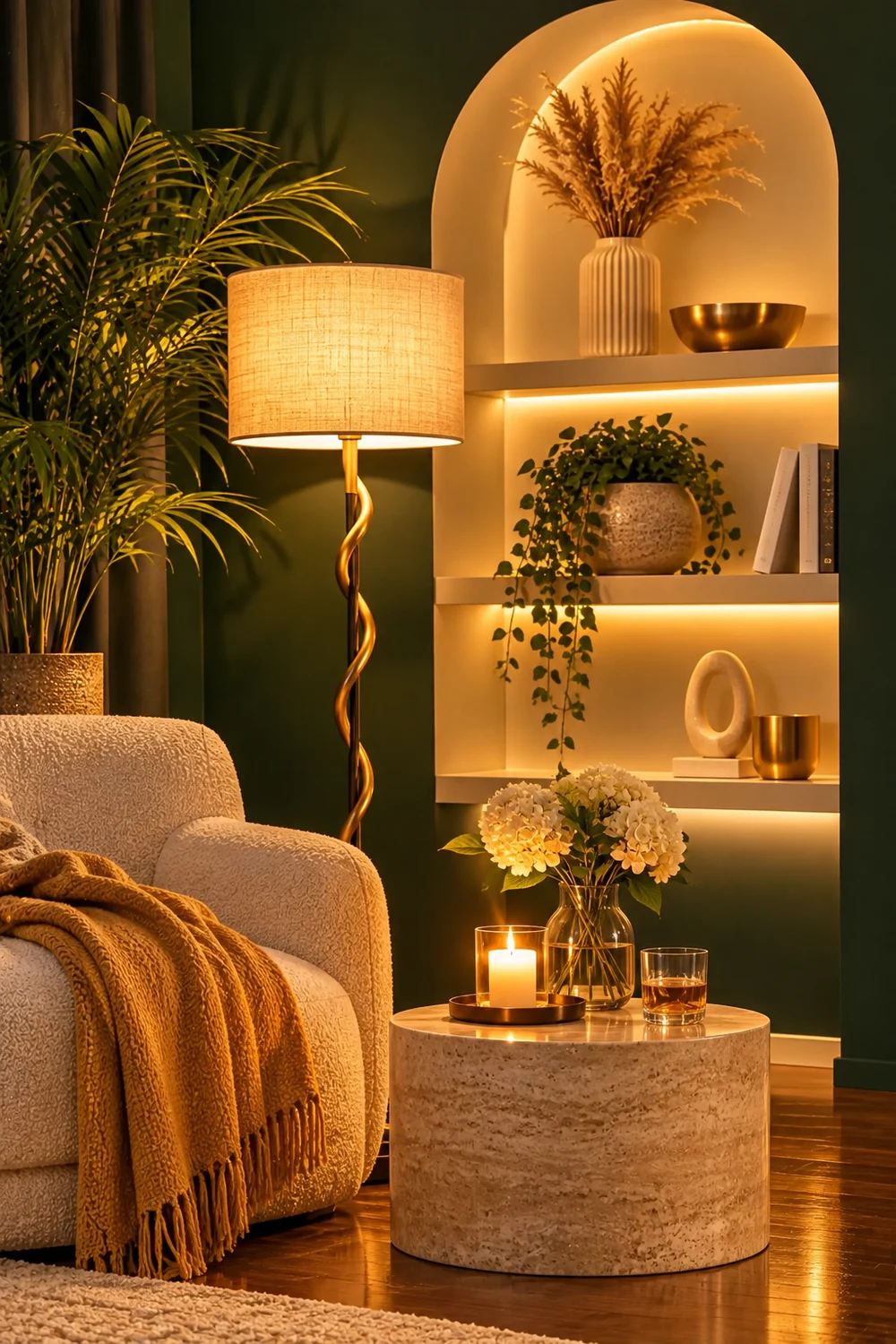
Design illustration created for Wokxa Living. It shows the idea, not a specific product.
Image: an AI-styled illustration of the idea, made for Wokxa Living. It does not show a specific product.
A lit shelf wall is the cheapest thing you can do to a room that still reads as expensive. It is also the easiest to get wrong, and when it goes wrong it looks like a shop display rather than a living room.
The difference is almost never the quality of the strip. Cheap strips and expensive strips put out similar light. The difference is whether you can see the light source from where you sit, what colour that light is, and whether there is anything on the shelf worth lighting.
Here is what actually matters, in the order it matters.
Why a lit shelf wall works at all
A ceiling light pushes everything down and flat. A lit shelf does the opposite. It puts a soft pool of light at eye level, which is where your eye naturally goes, and it gives the room a second plane of depth. Three things make it read as designed rather than decorated.
The light should fall, not shine
You want to see what the light is doing, not where it comes from. A strip aimed down onto the shelf below washes the surface and the objects on it. A strip aimed out at the room is just a bright line in your eye and it ruins the effect instantly.
Warm light makes materials look expensive
Wood grain, ribbed ceramic, dried stems and brass all come alive under warm light and go flat under cool light. The same shelf styled identically will look like a boutique at 2700K and like a pharmacy at 4000K.
Darkness around it does half the work
A glowing shelf in a brightly lit room is invisible. The glow only exists in contrast. This is why the effect is so strong at night and why it is worth putting the ceiling light on a dimmer at the same time.
Want more warmth without rewiring?
Our guide to the dimmable arc floor lamp covers reach, shade height and how to place it over a seat.
Which LED strip to buy, with numbers
Ignore the marketing on the box and check these five things. They are the only specifications that change how it looks.
- Colour temperature: 2700K. This is the warm candle-adjacent white you want in a living room. 3000K is acceptable and slightly crisper. Anything at 4000K or above will make the whole wall feel clinical, no matter how nice the shelves are.
- CRI 90 or higher. Colour rendering index is how honestly the light shows colour. Cheap strips sit around 70 and make wood look grey and skin look ill. CRI 90 and up costs a little more and is the single biggest quality jump available to you.
- At least 60 LEDs per metre, ideally 120. Low density strips give you a row of visible dots instead of a line of light. 120 per metre is close to continuous even without a diffuser.
- 24V rather than 12V for anything over about two metres. Long 12V runs lose brightness toward the far end, so one side of the wall ends up dimmer than the other. 24V holds up over distance.
- Dimmable, with the dimmer bought at the same time. Full brightness is almost always too much once the room is dark. You will end up running it around half. Buy the dimmer with the strip so you know they are compatible.
Single colour warm white, not the colour changing kind. RGB strips are tempting and they always end up looking like a games room. If you want one piece of advice from this whole article, it is this one.
Where to hide the strip
This is the part that separates a glow from a gadget. The rule is simple: from the main seat in the room, you should not be able to see a single diode.
- Mount it on the underside of the shelf, at the front edge. Not the back. Front mounting throws light across the full depth of the shelf below and washes the back wall. Back mounting lights the wall and leaves the objects in shadow.
- Set it back about 20mm from the front lip. Far enough that the strip itself is hidden by the shelf edge when you look from a seated position, close enough that it still lights the whole shelf.
- Use an aluminium channel with a frosted cover. This is the upgrade people skip and then regret. The channel hides the dots, spreads the light evenly, pulls heat away from the diodes so they last longer, and makes the whole thing look built in rather than stuck on.
- Run the wiring out of the back corner. Drill through at the back of the niche where the shelf meets the wall. A visible cable down the front of a lit shelf cancels the entire effect.
- Light every shelf or light alternate ones, not a random few. Rhythm reads as intentional. Three lit out of five, chosen at random, reads as something broke.
Styling lit shelves so the light has something to do
Light needs texture to catch. A shelf of flat glossy objects under a strip just produces hotspots. A shelf with ribbing, stems, weave and matte curves produces shadow, and shadow is what makes it look like a photograph.
Leave a third of each shelf empty
The empty space is where the light pools, and the pool is the whole point. Full shelves absorb the glow and you lose it.
Put something trailing on at least one shelf
A trailing plant breaks the horizontal lines and casts the best shadows of anything you can put up there. It is the single most photogenic item on a lit shelf.
Use texture on purpose
Ribbed and fluted ceramic, dried pampas or branches, unglazed stoneware, open weave baskets, brushed brass. These all come alive under a raking light. Shiny chrome and glass do not.
Vary the heights across the wall, not within each shelf
One tall piece per shelf, placed so the tall items zigzag up the wall rather than lining up. Lining them up gives you a column of shadow straight down the middle.
Common mistakes
- Cool white light. The most common one by a distance. If the wall looks blue in photos, this is why.
- No diffuser channel. You see the individual diodes reflected in every glossy surface on the shelf. Once you notice it you cannot unsee it.
- Strip visible from the sofa. Sit down in the actual seat before you fix anything permanently. Standing up, the strip is hidden. Sitting down, it often is not.
- Running it at full brightness. Lit shelves are mood lighting, not task lighting. Dimmed to around half is where the glow lives.
- Leaving the ceiling light on. The glow only exists against darkness. Turn the main light down and the shelf wall does the work for the whole room.
- Cramming the shelves. Objects shoulder to shoulder leave the light nowhere to land. Fewer things, more gaps.
Fix the colour temperature and the hiding place and you have most of it. Everything else is refinement.
Quick questions
Do I need an electrician?
Not usually. Most LED strips run off a low voltage plug-in driver, so it is a plug socket job rather than a wiring job. You only need an electrician if you want it hardwired to a wall switch or fed from a new circuit.
Will the strip damage a wooden shelf?
No. Modern low voltage strips run warm rather than hot, and an aluminium channel pulls the heat away. The adhesive backing is the part that fails over time, which is another reason to use a channel instead of sticking the strip straight to the wood.
How long do they last?
Decent strips are rated around 30,000 to 50,000 hours, so years of evening use. Running them dimmed and in a channel extends that, because heat is what kills LEDs.
Can I do this on open shelves rather than a built-in niche?
Yes, and it works well. Mount the channel on the underside at the front edge exactly the same way. The only difference is that there is no back wall to catch the light, so the effect is softer and you lean more on the objects to carry it.